As many of you already know, February is National Pet Dental Health Month. Do your pet a favor and take a few seconds to take a peek at his or her teeth- a GOOD peek. You might be surprised at what you find.
According to many veterinarians (including this one), periodontal disease is the most commonly diagnosed disease in dogs and cats. According to Dr. Brook Niemiec, “By the age of just two, 80% of dogs and 70% of cats have some form of periodontal disease.” As a board certified veterinary dental specialist, he knows what he’s talking about.
There’s a double whammy with dental disease- not only is it pervasive, it’s sneaky. Sometimes the signs are obvious- painful eating, bad breath, obvious tartar and plaque accumulation. But most of the time that is not the case. It takes a thorough physical examination and usually sedation to truly understand the state of your pet’s mouth.
Here are three things to do in order see if your pet is one of the 80% with some form of dental disease:

1. Look at their mouth while they are at rest. How do the teeth look? Are the gums pink or red and inflamed? Is there discoloration or bad breath?
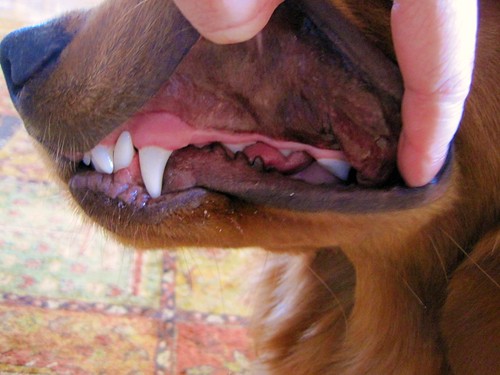
2. Lift up the lip on the side of the mouth and get a look at those molars in the back. This is where the real junky stuff likes to hang out. I still get surprised at how nice a mouth can look up by the incisors and still be a disaster in the back.
In this picture, Brody’s teeth are as beautiful as beautiful can be. Healthy gums, white teeth- what you would expect in an 8 month old dog. That being said, even young pets can still have retained baby teeth, fractured teeth, and tartar and gum disease. Which brings us to:
3. Have your pet examined yearly (ideally, twice a year) by your vet- who is trained to recognize the earlier signs of disease before they become a major issue. I take my pets in for regular dental cleanings. This routine care turned up three big things: Apollo’s infected molar, Calypso’s feline oral resorptive lesions, and Mulan’s oral melanoma. It’s important.

Our feline friends are often neglected in the dental category, which is a shame since they are especially susceptible to painful oral diseases. In the above picture (not my cat), the tooth with all the red stuff is a premolar whose root had been resorbed, and the gum tissue had grown over it in an attempt to “patch” the hole in the enamel. Ouch.
Above all, don’t be afraid to have your pet’s teeth cleaned regularly and early. Preventive maintenance is much better for your pet (and your wallet!) than dealing with the abscesses, extractions, discomfort, and systemic disease that eventually result from a poorly maintained mouth.
Tomorrow, I’ll tell you about a couple of my favorite products for dental care.


Great article and photos. And I love the slogan – Flip the Lip! I think you are on to something there… 🙂
Su had posted that on her Twitter and I thought it was a brilliant slogan.
Looking forward to the product recommendations, I know we need to be doing more to keep Frankie’s teeth looking more like those lovely pearly whites up there!
I would LOVE to see something that is easy to use and helpful for the tartar. It’s a fight to brush puppy toofies in my house!
I found out it was dental month through my new vet (who does housecalls). The clinic she has surgery rights at has a special this month, 10% off dental cleanings, as a way to help promote dental month. So maybe there are other clinics that do the same. 🙂
I think a lot of places are offering discounts this month- no better time to get it done!
Dental health is VERY important! For humans and pets! I should know, my dad’s a dentist! 😉
I don’t brush Topaz’s teeth, only because she eats raw food. Those chicken and marrow bones do a great job of keeping her teeth clean. Do you personally recommend raw bones?
You know, I really don’t have enough experience with the raw food diet to make a statement on it one way or another. I am Switzerland. 🙂
Great tips . Doggie #1 aka Stanley ( the firstborn LOLOL) has a cleaning scheduled this month.:-) the other 2 Max & Charlie are next in line. Do they have to knock a dog out to clean their teeth. Is ist safe??
We do cleanings under general anesthesia, as most vets do. It has risks just like any other general anesthesia, but it is overall very safe especially for pets who are otherwise in good health. I always recommend owners ask the vet what kind of protocol they use- do you do pre-operative bloodwork? Is my pet going to have a catheter and be on IV fluids during the anesthesia?
This is perfect. Thank you so much Dr V, I was slightly worried about it . Stanley is in good health, as are his two ” Brothers by other mothers” LOL , I will make sure to ask these questions you have identified. I feel much better about it now.:-)
As always you are the the best 🙂