One of the main reasons Iams invited a group of pet bloggers to Dayton for Behind the Paw was to show off the Pet Health and Nutrition Center in Lewisburg, Ohio. Before I get into what we saw at the facility, I wanted to give you a little background into the wild and wooly topic of animal research.
Background
It is obviously a controversial topic. An institution who is going to use animals for research purposes needs to have a clear justification as to the benefit of the research as well as established protocols in place for the physical and mental well-being of the animals.
A significant standard in animal ethics is the concept of the 3 R’s: reduction, replacement, and refinement. This is essentially an ethical guideline that anyone using animals in research needs to keep in mind when they are continually modifying their protocols:
- Reduction: using the least amount of animals necessary to get significant results.
- Replacement: taking advantage of technological innovations to replace animal models with computer models and in vitro models such as tissue and cell cultures
- Refinement: improving the study as it happens in a way that reduces the stress of the animals involved.
Setting up a research facility based on an animal-centric concept is no small feat. After all, in your typical academic research institution, the welfare of the animals is sometimes lower on the totem pole than the needs of a principal investigator with a big grant and research project at stake. But when you have a pet food company whose entire goal is to improve the lives of animals, well, you have some extra obligations there to meet and exceed those obligations to the research animals.
And you know what? They have. $265 million dollars’ worth of investment in alternatives to animal usage. Bravo.
How Animal Research is Conducted at Iams
Here are the facts about how Iams uses animals in research:
- 1/3 of the dogs and cats (about 700) are housed in the Pet Health and Nutrition Center, which will be the focus of this post. The remaining 2/3 are privately owned pets who are participating as clinical research trial participants, and pets who belong to private institutions such as Canine Companions for Independence.
- The only procedures performed on the animals, aside from spay and neuters, are those which a healthy human would also volunteer for. Translation? Urine is collected by free catch, for example, instead of cystocentesis. Aside from the occasional venipuncture, there isn’t much they have to deal with.
- There are no euthanasias, no terminal procedures.
The Life Plan
One of the most impressive aspects of the pet care at Iams was presented to us by PhD animal behaviorist Jessica Lockhart. Starting in 2006, Iams began giving each new pet in their care a “life plan”- a commitment to their well being that starts when they enter the facility and follows them through their life until their adoption into a permanent home.
 Cats are born at the facility into a SPF (specific pathogen free) colony to avoid the nastiness that is FVRCP, FIP, corona, and all of that yucky viral stuff. They undergo kitty kindergarten socialization programs, which are the best way to ensure you have a well adjusted cat who enjoys the company of people throughout their lives.
They are group housed in what can best be called cat nirvana, a landscape of vertical hideaways, tunnels and outdoor enclosures. Here they live, eating and playing and horsing around until their time is up and they have to go to a boring old regular house like all the normal cats out there.
Dogs undergo a thorough training and socialization program, including an off-site socialization period during the critical puppy period so that they are ready and able to transition into civilian life at 6 years of age. If a puppy does not adjust well to life at the Pet Health and Nutrition Center, they are adopted out sooner.
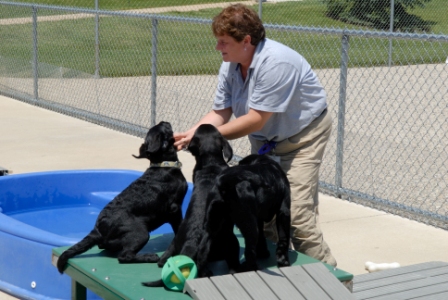 Dogs receive daily walks, positive training, and play time. They in fact get more walks than Brody does, much to my chagrin. When a pet is getting ready to transition into a permanent home, they spend time in the ‘living room’ at the PHNC where they learn such important things as: no, you can’t sleep on the couch; yes, that is a TV and it won’t get you; that smell is microwave popcorn and you will probably like it very much.
The Sound of Success
“Listen to this,” said P&G External Relations Manager Jason Taylor, gesturing to me as we walked into the area where the dogs are kenneled.
“What?” I said. “I don’t hear anything.”
He smiled triumphantly. “That’s right! A roomful of calm black labs and not a single one of them barking. That’s what our training programs have achieved.”
I thought about that as I reached into a kennel to pet a mellow and tail-wagging Koa lookalike, confidently approaching me at the front of her kennel. I remembered back to when I first met Nuke, who had spent 10 years in a kennel with no enrichment or regular attention. Nuke, the university research dog I loved, jumping 10 feet in the air, so anxious for human interaction he seemed to levitate with desire for touch. There was none of that desperation here.
The facilities
The thing that struck me most about the Pet Health and Nutrition Center was how very un laboratory-like it seemed. It was, in fact, much more reminiscent of a high end boarding facility. Dogs jumping in pools, dachshunds zooming around on a grassy hill, cats snoozing in the sun. If I were a conspiracy theorist I would say geez, they really put on a good show here. But really, you can’t fake an entire facility. It really is that nice.
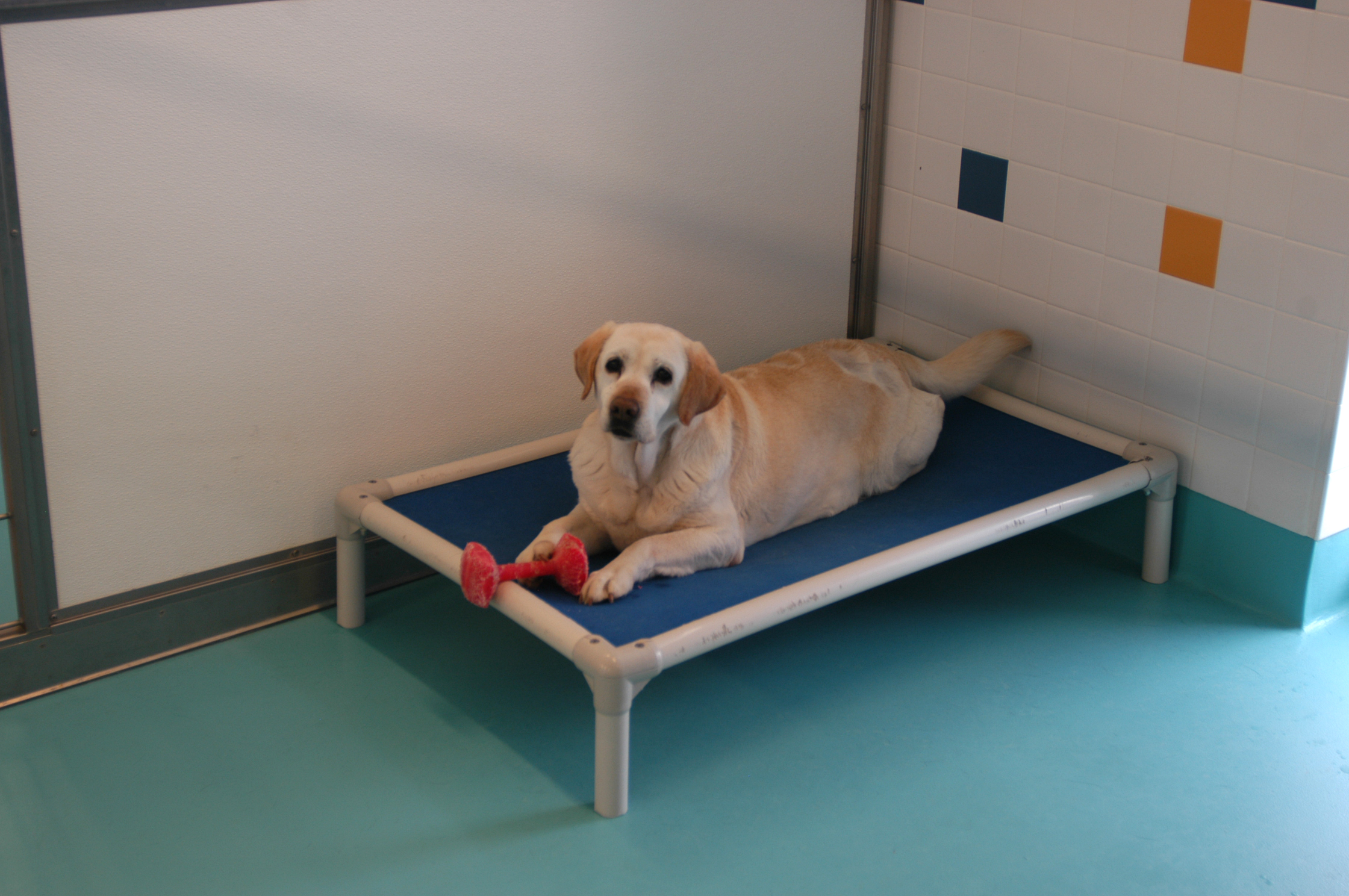
The natural light you see peeking in the back comes through the specially designed vertical dog doors that are in all the kennels. The kennels are half inside and half outside, so the dogs can choose where they would like to hang out. Dogs are pair housed or individually housed, depending on their own preference. In addition, the walls are arranged so that dogs can place themselves away from visual contact with any other dog in the kennel, if they are feeling shy and want some alone time.
The one thing all of us said at the end of the summit was, “Geez! Why aren’t you guys showing this to everyone, every day?” The pictures we have in our posts were provided by Iams, though were I to have taken pictures, this is the same thing you would see. Lawyers make everything complicated, I guess.
Personally, I want them to put in a webcam. It would be pretty cool and would really help their desire to make the process transparent. There’s nothing to hide. I’ll keep lobbying them. 😉
Giveaway!
OK! So you sat through the PETA dissertation and came with me through the Pet Health and Nutrition Center. The least I can offer you is some of the food they go through all of this to make, right?
In honor of Brody’s birthday, Iams/Eukanuba has donated to me 4 certificates, each good for an 8 pound bag of dog food. I have 2 for Iams dog food and 2 for Eukanuba. To enter, just comment with the name of which Iams or Eukanuba dog food you’d like to try. (I won’t hold you to it.) And if you’re swimming in dog food, enter anyway- everyone knows a shelter or rescue who would be happy to have it. I will choose 4 winners at random at 11:59 PST June 8th. Bone appetit!


We feed our dogs the Iams Proactive Health Lamb & Rice formula. And the cats get Proactive Indoor Weight & Hairball Control.
Tucker can’t have either brand due to his allergies, but I’d love to donate some to our local shelter!
I’ll take any of them — to donate to the rescue group for which I volunteer.
Thanks for the info, Dr. V. This is really a good thing to see!
I’m interested in the Eukanuba Dachshund formula!
Niki (the worlds most polite shelter dog) eats the Iams Proactive Health Lamb & Rice formula. We would like to donate any winning to the local shelter.
it’s good to hear the animals are so well cared for.
One question, in the video you posted you referenced some dogs that were recovering from a muscle biopsy. Is that still happening? Because that sounds more invasive than what I might volunteer for (urine and blood samples).
Thanks for the great posts! Can you check find out about Hills practices next?!
Nope- that sort of invasive testing has ended.
I would love to know about Hills! Maybe they can invite me! 😀
I would like to try Iams
Thanks for your post. Lots of great information. One thing I would like to know is if Iams/Eukanuba uses rendering during any part of its food production process. Can you tell me that?
That is a good question. Let me get someone from the company to address that.
Have you heard anything yet?
OK- I am assuming by rendering you are referring to the process whereby a bunch of stuff is just kind of tossed together willy nilly into a big pot and cooked down to remove moisture and separate all the fat, the big concern being that who knows what is actually in there. The answer is, no.
“Our proteins are raised and processed specifically for purposes of consumption, and are exactly as stated on the ingredient panels. This being such a highly regulated industry, and in many cases our protein is sourced from the same suppliers as human foods, there simply is no way this could be the case. Plus, in most cases, it’s illegal.”
To add, I saw in the manufacturing plant the area where the meat is kept. It arrives in its raw form so all processing/cooking/packaging takes place in the same plant, and doesn’t arrive pre-cooked in any way.
Does that answer your question?
Yes, thank you!
Have you guys seen the videos at this website? It doesn’t seem to me to jibe with what you have posted here. The video of the dogs lying on the floor is particularly disturbing.
Hi Jo, if you look at my post from yesterday this is addressed in great detail.
I am impressed! I’d love to donate a bag of either to a shelter! My pup uses a different food but we all know that there are others in need!
Thank you for this excellent, fair-minded series. I can’t give Frankie any commercial dog food because of his diabetes so I’d donate to a shelter, but I really just wanted to stop by and say great job in detailing a complex issue so clearly.
Thank you, this is fascinating. Do you know what (if any) federal legislation is in place to enforce the “three R’s” standard or other ethical standards in animal testing?
I will make another post about USDA and the Animal Welfare Act- it’s complex enough to deserve its own post.
After spending my evenings bushwhacking through the Code of Federal Regulations, I believe you. Looking forward to the upcoming post!
I would take any of the foods, i keep a small bag in my car at all times to either use it to lure dogs into my car (wow, i sound creepy!) so they can be rescued (I live in new orleans and we have a lot of strays)! or to give out to people that might need it for their dogs.
What a great idea! I love that.
Our cat’s get Iams – either the regular or the natural (they eat just about anything Iams – they hate science diet). We’re looking to adopt a dog next month (after our vacation so we don’t abandon our new pup right after getting him/her!), and will probably feed the dog Iams, since we’ve had good luck with it for the cats. It will be my first dog ever and I am so excited! I would love a free bag of dog food!
Oh, and any suggestions on integrating a dog into a 2 cat household would be greatly appreciated!
Thanks!
My local rescue would love some Iams food! (any kind)
I think many feel pet food makers are the bad guys. Your posts are showing that, while they may have had problems in the past, they are truly making an effort to do ‘good.’ That is wonderful! Thank you, Dr. V, for sharing your experiences 🙂
I use the large breed weight control from Iams. Thank you for the chance to win.
What? No cat food? Ah well – my local shelter will appreciate even if my cats don’t.
I would love for Dexter to try Eukanuba’s performance formula!
I’d be happy to donate my winnings to my local rescue!
It seems like an awesome place! Thanks for showcasing it.
Our Shelter ( SHAID ) http://www.shaid.ca/ would like either of the food for sure.
opps forgot to mention Iams/Eukanuba 🙂 Our shelter won’t care which one..
http://www.shaid.ca/
I had no idea that Eukanuba made so many different types of formulas. I would love to try the small breed weight control formula. I have 2 little dogs – 1 that burns it off and the other that could use a little assistance. Would love to switch them to this.
Very interesting stuff. My dog gets Iams Premium Protection (on my way to go get some right now) so another bag would be greatly appreciated!
I’m up for the IAMS – all our furry friends for the last 30 years have dined on it and people were always asking why our black lab had such a beautiful coat.
Thanks for all the info on this facility – I agree with you, a webcam would send a lot of good info out there and I can watch dogs all day long!
Iams mini chunks is what Lola would like to try!!
My dogs eat Eukanuba and the kitties get Iams!
I’d be interested in Eukanuba!
I am about to switch from puppy to adult food for my new pup, I would love for her to try Iams adult mini-chunks.
I would LOVE to try Eukanuba Pure Puppy Growth, I have tried just about every food out there and slowly becoming frustrated. I have two small dogs that I would love to try this on. I think in the last two months I have provided so much puppy/dog food to our local shelter that all the dogs who didnt have food now have food from my two picky pups that they wouldnt eat! My vet just suggested that I try Eukanuba or Iams. Thanks so much for a chance to win, I love reading these articals 🙂
i just dont buy it sorry,ive seen all the pictures on another website of really MISERABLE ANIMALS,IAMS CRUELTY.