One of my primary goals when I am invited to tour a pet food manufacturer is to see their animal welfare policy in action. It’s probably one of the most commonly asked questions when it comes to pet foods: do you use animals to test your foods? And how do you use them?
There was a time, a little over a decade ago, when animals were used quite a bit by various companies. They were used in various ways, including terminal studies in which the animals were euthanized at the end of the study. (Though I was told by Dr. Karen Johnson at Hill’s Pet Nutrition that as far as she knew, Hill’s has never participated in or funded terminal studies.) How things have changed.
Animal Welfare Policies have become the norm with pet food companies, usually readily available on the company website. Hill’s policy is to use only non-invasive methods for which there is an equivalent human comparison, which is limited to data collection via physical exams, bloodwork, and fecal and urine evaluations. This has become, as far as I can tell, the standard in the States- and I am glad for it.
So why do companies still use animals? And what’s their life like?
Feeding Trials
Pet food companies that utilize animal testing do so in two ways: on site testing and clinical research. In the latter, client-owned animals in the community participate in feeding trials, often to evaluate the efficacy of a diet for a medical condition. This has the benefit of evaluating the diet in the context of naturally occurring disease, in a real-life environment with confounding factors like a dog who steals the other dog’s food, that sort of thing.
On site testing is used in a couple of ways: one, for palatability testing. Studies show, for example, that contrary to what you might thing, cats don’t really like the taste of fish. Dogs, however, do.
Another goal of on site testing is to complete feeding trials. When you look on a bag of food and it says, “Animal feeding tests using AAFCO procedures substantiate that Blahdiblah Adult dog food provides complete and balanced nutrition for maintenance of adult dogs”, this means a company has completed a feeding trial as opposed to simply formulating a diet to meet criteria specified by AAFCO, which is the other way a company can determine nutritional adequacy.
One of my fellow bloggers asked at the Hill’s tour if there were times a diet formulated to meet AAFCO standards didn’t pass muster at a feeding trial, and the response was, “Absolutely.” It is generally accepted that, though they are more expensive, feeding trials are the better of the two methods- for reasons like this.
So what is a feeding trial, anyway?
Here’s a summary of the requirements for proving an Adult Maintenance claim for dog food, per the AAFCO manual:
- minimum of eight healthy adult dogs at least one year of age
- test runs a minimum of 26 weeks
- the diet must be the sole source of nutrition
- daily food consumption recorded
- body weight measured weekly
- Blood parameters measured are: hemoglobin, packed cell volume, albumin, and alkaline phosphatase (a liver enzyme).
AAFCO then goes on to specify parameters for those body weights and blood values that must be met in order for a diet to receive the AAFCO label. There are different tests for different label claims such as growth or gestation, but that is one example.
The Hill’s Pet Colonies
Hill’s maintains two colonies: a dog colony and a cat colony. I didn’t note the exact numbers but I believe it’s about 400 of each. The dogs are purchased from a breeding facility; mostly beagles, though the breed can vary. The cats are also purchased from a breeding facility, and run the gamut as to breed.
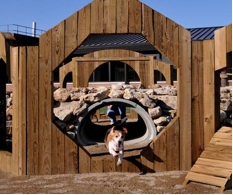 The animals live at the Hill’s facility for their natural lives unless they have a difficult time in a group setting, in which case they are adopted out. The dogs live in groups of about 20 in rooms with plenty of natural light, either in paired kennels or individually based on their preference. They have daily outdoor exercise and socialization with the dedicated staffers.We saw plenty of pups zipping around the bark park, playing tug-o-war and doing the sorts of things dogs like to do.
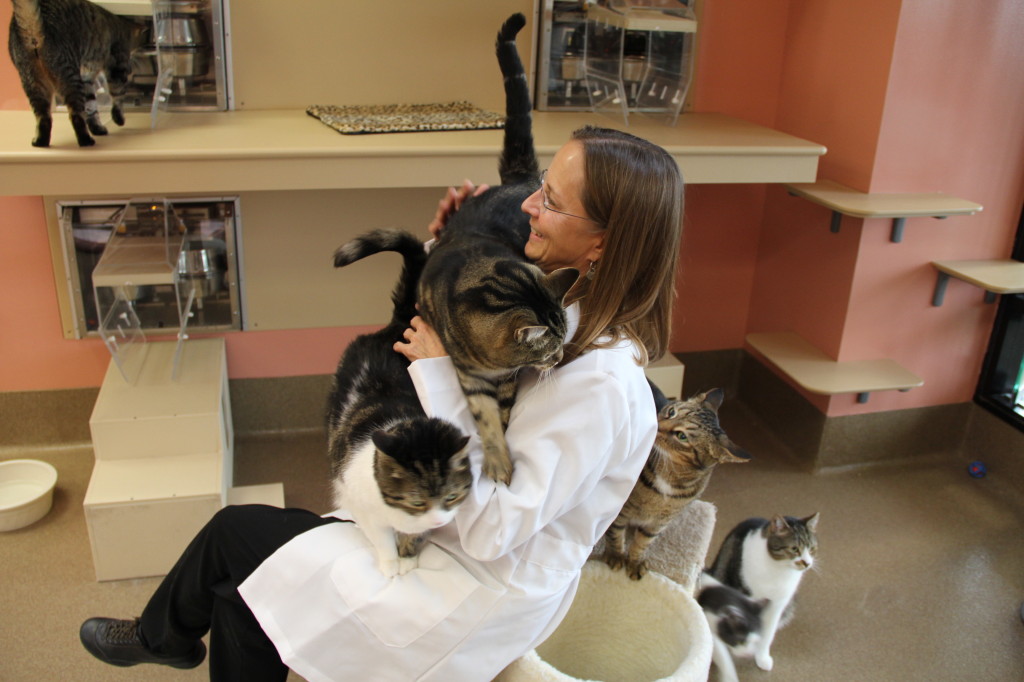
The cats have group-living rooms with perches and toys, and access to a sunroom for lounging as well. When we were there, we saw the staffers testing out an exercise machine that could best be described as a big hamster wheel to run around on. They all seemed happy and relaxed.
Medical care: As I would expect in a pet food company founded by a veterinarian, the health care provided for the animals on site is top notch. There is an AAHA-certified full service veterinary hospital on-site, with surgical suites, radiology, and ultrasound to provide for the animals’ needs. While we were there, we saw the staff setting up for the dogs’ annual dental cleanings.
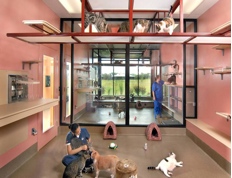 My general impression: the animals are happy and well adjusted, and their well-being is a priority at the facility. That made me happy. Employees are encouraged to take the dogs and cats out for interactions; they can even have meetings in a room where the cats can come in for pets.
I don’t think, though I would need to ask each and every company individually to verify this, that any pet food company does terminal or even invasive testing any longer. It seems like it is no longer the accepted standard for pet food companies, and with the exceptional alternatives available these days, it’s no longer necessary. That is a good thing.
Any questions about what I saw at Hill’s?


Annual dental cleanings?! I had hoped/assumed that a pet food manufacturer would also test the long-term effect their food has on a pet’s dental health. I’ve always preferred Hill’s over various other brands we’ve tried, but I am definitely looking for pet food that will help keep my pets’ teeth clean and healthy without such a procedure, annually to boot!
Will you also be visiting any such breeding facilities?
Thank you.
Well, remember even with excellent dental care we need cleanings twice a year too. I’ve heard really good things about t/d but I don’t think there is a food in existence that can *replace* dental cleanings.
Any openings for employment? :p
If you’re in Topeka, probably! 🙂
Why beagles?
beagles are easier to breed en masse.
beagles are easier to breed en masse.
beagles are easier to breed en masse.
They said they aren’t opposed to other breeds but it is just what their supplier has. Beagles are a traditionally used dog in research because of their size, temperament, and health. There are breeding facilities that specifically supply dogs to research labs (that’s where my dog Nuke came from.)
sorry, but this really disturbs me. they effectively put money in the pockets of those that make money off animal testing. i wholeheartedly don’t agree with this. there are scores of puppies that are euthanized in shelters because of lack of space…i don’t understand why hill’s can’t adopt them.
add to that, i don’t buy any hill’s products because of what they actually put in their food. my dog and cat get grain-free options – my dog gets food that scores 5 stars on dogfoodanalysis.com. hill’s products get 1 star.
yes, the facilities look nice, but to me the proof is in the pudding, as the saying goes.
It sounds like they do a great job of providing for their animals. Bravo! My only question is: Why can’t they find rescues as oposed to buying them from puppy mills (aka breeding facilities) ?
I understand it would be a much more labor intensive to go out and find ~40 dog and cat candidates per year that would fit their requirements, but I’m sure they could recoup a good chunk of that with the awesome PR.
BTW I really miss your “real tales from the office” posts with the little bear(?)bunny(?) proxy things.
*opposed*
*opposed*
*opposed*
I think the general consensus is that it has to do with disease control but I am not entirely sure.
I completely support this question. If they get dogs who have been sufficiently vetted, it seems to me that it would be an even better test for them, because they would be using different breeds with different requirements – and potentially different health statuses, which I would think would give them better info. I’m glad they have good facilities for the dogs, but I give a big thumbs down for the breeder idea.
My initial reaction was ‘boo to the breeder’ also, but then as a shelter worker i tried to decide if i would be ok adopting one of our animals to go live as a food tester for the rest of its life. And the answer is ‘no’. i’m pretty sure most shelters and rescue groups don’t have a pet food company in mind when trying to re-home their pets
Good point.
I’m glad to hear they provide posh living accommodations and great medical care, although I guess I kind of expect that this day and age. It is disturbing to hear that they get their cats and dogs straight from the “factory”. Partly because they are not a representative sample of the population at large, but I suppose maybe they are trying to cover that with with the off-site feeding trials. I agree with Scott, I think the extra cost of taking in rescue cats and dogs could easily be offset with very positive PR.
What are the conditions of the their source ingredients animals? What standards do they hold to for those sources? Do you ever get to tour such a facility where the source animals are raised?
I’ve never gotten an offer to tour such a facility. Some are domestic and some are not, though to a one I think companies are responding to increased sourcing scrutiny after the melamine incident.
Gotta give them kudos for that.
another propaganda by Hills after FDA slapped them for misleading claims.
All big companies are know for lies. For better pet food cook food for the pets in your kitchen and feed them pet supplements it is healthier than feeding Hills, Mars or Purina products
My issue with Hill’s is that they use corn fillers and animal by-products. And chemical preservatives. I find it sad that so many people are so proud of feeding SD instead of the “cheap” brands…
Also, why fund breeders and puppy mills instead of taking animals on death row at animal controls??
I’m glad to see how the animals are living but what kinds of tests do they do on the animals? How long do they keep each animal, at what age do they retire? So all they do is feed, weigh and take blood from these animals and thats it?