When I was in college, a friend of mine decided to get a rabbit. She brought it home, purchased all the necessary bunny-equipment, and then about one week in realized she was living with Bunnicula. Far from being the sweet and docile cat-substitute she was hoping for, this bunny was a real demon.
It chewed up the carpet. Every time she picked it up, it pooped all over her. When she opened the cage, it would hiss. No, really, it hissed. This was not a nice bunny. I’ve never met a rabbit who disliked humans as much as this one.
Nonetheless, it was her bunny, so when she decided that it wasn’t going to work out and she was going to set it free to be a feral bunny, I had to step it. Keep in mind we lived in coastal Los Angeles, otherwise known as the Concrete Jungle, and this rabbit had lived the entirety of its short life in captivity. We had a talk, there was some waving of hands, and after all of that she found a place for the poor misanthropic lagomorph in, of all places, a petting zoo. No, it wasn’t ideal, but certainly better than what she had initially planned, so I had to take whatever small victories I could get.
My point is, we humans are terrible when it comes to the decision making process. “Turn them free,” we say when we want to be free of the responsibility we’ve taken on, with zero thought as to the consequences.
In some cases, what we do is doom the poor creature to a slow death from starvation, exposure, or predation.
In other cases, we trash an entire ecosystem.
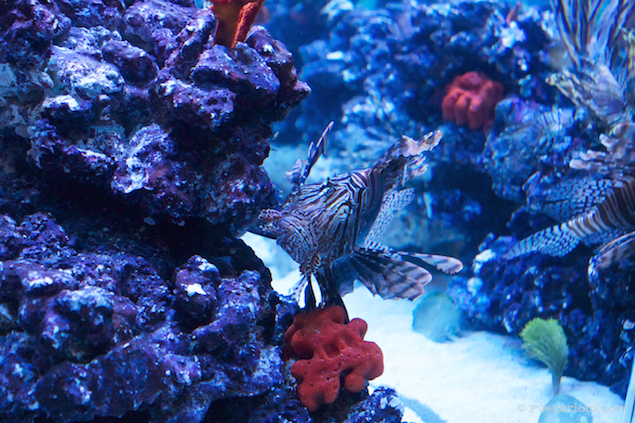
Behold the lionfish. A native of the Indo-Pacific region, lionfish began turning up in the waters off the coast of Florida in the 90s. How they were introduced, exactly, is not certain, but the prevailing theory is that they were put there by people who no longer had use for them in their own aquariums. The initial number was small, that is agreed upon.
In ten short years, this invasive species has become one of the most abundant species on the Atlantic Coast, extending from North Carolina to the Gulf Coast and the Bahamas. They are aggressive carnivores with few predators- their poisonous spines confer a great deal of protection. With plenty to eat and no one to stop them, the lionfish numbers exploded, and the coral reefs have suffered.
Voracious eaters and prolific, year-round reproducers, lionfish have reduced their prey fish populations up to 90% in densely populated areas. As you can imagine, this has wreaked havoc on the delicate ecosystems off the shore. All of this from a relatively small number of fish released into the ocean by our fellow humans, a very short time ago.
Fortunately there are people paying attention, and they are working in as many ways as they can to mitigate the damage. The REEF organization of divers and marine enthusiasts started a Lionfish Research Program to educate the public and recruit divers to help in the population control efforts. They’ve partnered with an impressive array of organizations like NOAA, USGS and the Fish and Wildlife Service to that end.
I learned about REEF at Global, through the Boyd Enterprise booth, which donated a 500 gallon aquarium specifically to house lionfish and get people over to learn about the lionfish invasion. What I find particularly fascinating, in addition to the population biology itself, is how important the diving community is in this control program.
Some of the data I read suggests that 27% of the existing population needs to be removed every year just to sustain the current population size. That’s a huge job, and REEF has figured out that one group working alone just won’t be enough to deal with it. So they recruit dive clubs and researchers and local organizations, encourage local restaurants to serve lionfish, and organize dive trips with the specific purpose of capturing them. And then they get aquarium companies like Boyd to help them get the word out to people like me at events like Global, so people like you can hear about it too.
It’s grass roots work at its finest. Humans created this mess, but hopefully, humans can also fix it. It’s a reminder that it doesn’t always take an army to make a big impact, for good or for ill.
For more about the lionfish invasion, check out:
National Oceanic and Atmospheric Administration


I have a huge, crazy, fear of fish. Even small fish, cute fish, FINDING NEMO fish. I just can’t do it. I can’t swim in a lake or ocean. So that picture just about made me die on the spot. Then to read they have spikes and eat toes, yup. Just confirmed why I dont swim in open water.
On another note, I hissing bunny? huh, who knew?
This kind of information should be in the “General Life” course that includes balancing a check book, contraception information and filling out a job application properly. We need to teach our children to make good decisions so that they don’t (in their ignorance) perpetrate damage to themselves, other creatures, or the environment in general. I can’t imagine people would really just “setting them free!!!” if they had a clue about the possible consequences. Once again, thanks for the info, Dr. V!
First, that is a GREAT picture – the blues and reds are just phenomenal! Second, I had a rabbit that first marked me (peed on me), then (later in our relationship) would run circles around guests and hiss at them. He was very protective. Finally, a great message on the lionfish. I had no idea and I will share on my Facebook account.
I was just at the new Cleveland Aquarium and they never mentioned a word about the situation in Florida even though our lion fish come from Florida. Missed opportunity indeed
Oh the things people set free down here in FL …
pythons, turtles, spiders …
and aging New Yorkers in Cadillacs … its a very frightening place to be this time of year 😉
On the bunny thread…. humans kid ourselves about the depths of our “domestication” skills. And don’t even get me started on deer….. they will mess you up and try to kill you as easily as freeze or run given the right circumstances. I blame Disney! 😉
I have a friend who lives in Curacao and learned of this from him. He has occasionally posted pics from his “lion hunting” and subsequent barbecue! I do think he’s part of a larger group as he has reported a “100 lion fish” day. I agree with the idea that this is a lesson that should be taught widely.
Thank you so much for bringing this to our attention. I had no idea! But I know people seem to think ‘setting them free’ is merciful 🙁 If only they knew what that really means.
I wish we had more general education courses on animals, managing money, computers and etiquette (not 1950’s version), because we would all be better off and so would everyone else around us.
Too bad she didn’t get the bunny neutered:( That probably would have helped a lot. Hormonal rabbits can be very over-bearing indeed.
Bunnicula!!!!! You rock. That is all ” )
that is a GREAT picture!
Actually, it’s likely that most of the lionfish actually were a result of Hurricane Andrew (Genetic surveys of the Florida fish indicate most of them came from a population of about 6 individuals). Also, lionfish are delicious (taste just like grouper), and spearfishing tournaments off the coast of Florida and in the Caribbean bag thousands every year. So, my ideal solution? Start selling lionfish in the restaurants and grocery stores, and make it legal for non-commercial-licensed spearfishermen to sell their lionfish catch (as it is not now and carries jail time equivalent to selling several kilos of cocaine).