Disaster Response
by
Dr. V | Thursday | January 3, 2013 |
Being set up in the house with all my computer equipment finally reassembled means I can do what I’ve been wanting to do for quite a while: fill you in on more of the disaster response trip I did with World Vets in Nicaragua. I think the last time I had left it, we had just spent a day in the classroom learning disaster response techniques and were about to put our skills to the test.
Day 2 was the water course. I’m not the strongest swimmer, so this was the part I was a wee bit nervous about. As you will see, this was with good reason. The universe does not think I should do a lot of things in the water. But first, a lovely picture from our tour of Granada on the first day to set the stage for calm:

You can see why Granada was a favorite sacking locale for centuries of marauding pirates.
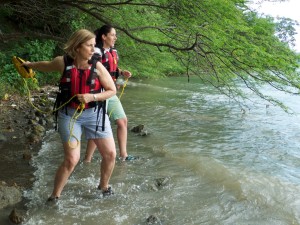
But I digress! We spent our water day at Laguna de Apoyo, a blessedly warm and quiescent lake in the crater of a volcano. Many disaster response training sessions focus on swift water rescue, which adds layers upon layers of difficulty when you are dealing with the mechanics of walls of water moving at different rates down a riverbed. Before you get there, you need to know the basics, such as how to put on a life jacket. You’d be surprised at what a complex piece of equipment a professional quality life preserver is. It’s like strapping into an extremely padded corset.

“Double check everything,” stressed our instructor Kim. “Make someone else check it. ALWAYS. SAFETY FIRST.” And I agreed, so I did just that, the first time.
By the third time I took the jacket off and on, sharing it with another participant, I was confident in my buckling abilities so I bypassed the check mechanism in order to get to the good stuff. Like how to throw a rescue rope.

You can throw it overhand, underhand, or sidearm, depending on your strength and accuracy. We were lobbing those ropes like pros in no time.
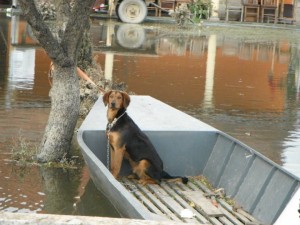
Having satisfied himself that we weren’t going to strangle ourselves accidentally, Kim divided us into teams. While one team got on a boat to practice rescuing a pet from the boat, the remaining group would stay on shore and take turns being a victim, throwing the rope, and swimming out to the victim to swim him or her back in. The person doing the swimming would do it both unassisted (you’re on your own) and assisted (meaning you are attached by a rope to someone on shore, who pulls you back in.)
First, I swam out to my victim and pulled her back in. Being a kind person she decided not to feign being panicked, hitting me, or trying to crawl on my back, which I guess isn’t that uncommon. We made it back in safely.

Next, I hooked the rope up to the carabiner on the back of my vest, and we re-set the stage for me to have an assisted rescue.
I reached my victim.
I waited for the reassuring pull of the rope.
“Man, they’re lagging,” I said. We floated about for a minute or two. I heard yelling.
“WHAT?” I said to the people on shore.
“This is the part where you both die,” they said. It was at this time I noticed the carabiner, with rope still attached, floating about 20 feet away, nowhere near me or my life vest. Again, good thing we were in a lake, right? As you can see, it was fortunate we were a) in 5 feet of still water and b) within rowing distance of Team B, had this been an actual emergency.
I swam sheepishly into shore on my own power, wondering what sort of defective piece of equipment I had been handed.

And of course, when I got to shore and assessed the breakdown, it turns out my dumb self had neglected to insert Tab A into Slot B on the waist belt buckle, meaning as soon as there was any tension, it popped right open, pulling the threaded carabiner with it.
There are routines you do because you’re trained to do them- counting sponges after surgery, for example, or double checking stumps for hemostasis before closure. Or in this case, make someone check all 15 buckles on your life preserver, every time. Because it’s not about making sure your chest is comfortably contained- it’s the difference between getting pulled to shore and screaming in frustration as you and your victim swirl off the waterfall downstream. Which is the stuff of my nightmares. Actually it should more appropriately be the stuff of anyone else’s nightmares, should they find themselves drowning and see me headed in to save them.
Lesson: learned. Don’t worry. It won’t happen again.
by
Dr. V | Thursday | November 29, 2012 |
“What time does your flight land?”
My husband asks me this every time I go to Nicaragua (OK, it’s only been twice, but still.) He asks because the State Department brief on Nicaragua mentions armed robberies along the highways at night, and he is worried that this will happen to me. And I appreciate his concern, I do, but I sometimes wonder what the State Department would say if it were telling travelers what to do when travelling out of LAX, an airport I lived by for 5 years, or what he would have said had he known I was hopping into a taxi by myself at 1 am in Nairobi, something he didn’t think twice about when I mentioned it after the fact but everyone who has actually BEEN to Nairobi thought was a particularly gutsy stupid thing to do.
The point is, you take calculated risks all the time in life, and do the best you can to protect yourself, because at the end of the day the coolest things in life require that tiny element of risk. Why did the chicken cross the road and all of that. Despite wanting to be able to talk about my mad danger cred, I have to be honest: not all countries in Central and South America can say the same, but Nicaragua was not a worrisome destination for me. At all.
For those who don’t recall why I am talking about Nicaragua, I was there a few weeks ago as part of the Inaugural Technical Animal Rescue course with World Vets. I didn’t talk about it too much beforehand for the simple fact that I really didn’t know what we were going to be doing, other than ‘learning technical animal rescue’ and that I would need a life preserver, but the element of surprise is what makes these adventures so great. And because I ended the course with a test, you get one too. That’s how we roll here. That’s how you LEARN, people.
True or false: Most travelers to Nicaragua end up robbed, jailed, or otherwise victimized.
The area of Nicaragua we were in (Granada) feels very safe. Violent crime is certainly more rare than it is here in San Diego, and the only assault I had was on my dignity during that awkward massage (but I digress). All that stuff you hear about the terrible Nicaraguan jails on Locked Up Abroad? Told by people who were smuggling drugs. Don’t do that. This place is crawling with tourists, who come with money to spend, and the community doesn’t want to jeopardize that by showing people a bad time.
True or false: Granada is ugly.

Granada is gorgeous. It is one of the oldest cities in the Americas, founded in 1542. That means there are lots of old, old churches;

Strange incongruous city blocks whose architecture depends on what century it was built in and which pirate burned it down;

And walls stretching to the horizon, punctuated by doors that lead into the unknown; could be a pharmacy. Could be a pile of rubble. Or it could be a beautifully manicured courtyard, such as that at Casa la Merced, where we were fortunate enough to stay.

I opened my bedroom door to this every day. Hideous.
True or false: World Vets hired some random bozo to teach the course as a front because we all just wanted to go to Granada.
On the first day of the course, we met our instructor, Kim Little from Rescue 3. The first thing we learned about him is that he has been teaching rescue courses professionally for three decades.

The second thing I learned is that he is teaching us the same material taught to the HSUS Disaster Response team and all the other big players you see on the news when disasters happen domestically. So we learned the real deal, FEMA certified, official course. By the way, if you ever invite Kim over for dinner, which you should, ask him to tell you stories from his rescue work during Hurricane Katrina. There’s a story with a tiger, and another story involving a massive pig, a crate, and a film crew.
And the third thing I learned was:
SAFETY FIRST
This is important, as I will get to when I talk about how during lake practice I accidentally demonstrated how one might accidentally kill both oneself and one’s victim during a water rescue, if one forgets this cardinal law.
True or false: Technical Animal Rescue involves the most complicated and expensive elaborate machinery that exists.
After our first day doing classwork, reviewing the hydrodynamics of swift water rescue and me getting to gleefully nerd out on vectors and flow diagrams, we sat down with the meat and potatoes of any rescue team: bags of ropes and carabiners.

It’s amazing what you can do with rope. No, really.
We spent more time doing knots than anything else in this course. Knots, and knots, and more knots. Knots that swivel and knots that pull and knots with two loops and knots that lay flat.

Those who have done climbing fared better than the others, but we all got it eventually. Dr. Augusto Barragan from Panama, seen here with Dr. Lester Tapia from Granada, was particularly adept. He spent a lot of time sitting opposite me trying to explain in his non-native language what I was doing wrong.

Answer: taking too many pictures.


Jen, having quickly mastered the lessons due to her climbing experience, started to freestyle.
Kim had but three precious days to whip this motley bunch of veterinary do-gooders into cool, calm rescue pros who could grab a duffle bag of ropes and clips, look over the edge of a ravine at a dog and human in distress, and figure out how to magically transform those tools into a successful rescue. After that first day of tumbled knots, things were looking grim, but we persevered.

Day One: The newly formed team gathers at the defunct Granada train station, wondering what we had in store.
But did we learn enough? Stay tuned.
by
Dr. V | Wednesday | August 29, 2012 |
As Hurricane Isaac bears down on the Gulf Coast, I, like many of you I’m sure, am remembering Hurricane Katrina. The relief when it was downgraded from a 5, to a 4, then a 3. It’s not going to be that bad. That relief turning to horror as the levees failed, a slow-motion catastrophe whose impact is still evident throughout the region and in the hearts of the millions affected.

To those in the area, I wish you one thing, to be safe. My thoughts are with you.
I can only hope that you have been able to use that warning time to come up with an evacuation plan for your pets as well. The tragedy there last time was almost too much to bear, people who could not take their pets to evacuation sites, leaving them for what they thought was just going to be a few days. Those pets, left for weeks, died. Those who made it to the outskirts were sometimes reunited with their owners, often not. Abandoned and alone while their owners despaired. Or another horror, those who were unable to secure a safe option for their pets and elected to ignore evacuation orders instead of leaving their pets behind, those who paid the ultimate price for their loyalty.
We have learned much from that disaster.
If you are not in the middle of this storm right now, watching the news with the luxury of room to breathe and think, I urge you to take just a few moments to ask yourself if you have a plan in place for your household. We all have some sort of looming natural disaster that could crop up unexpectedly, be it a tornado, a hurricane, an earthquake, or a wildfire. We are all susceptible to that unexpected fright in the middle of the night, the need to get out, fast.
1. Plan to take your pet with you.
We all like to assume it’s no big deal, right? We’ll be back, it’s a false alarm, etc. It’s human nature to do that. But if that road closes behind you, they’re not letting you back in for your pet, no matter how distraught you are. Our emergency personnel are charged with protecting you. You are charged with protecting your pets.
Make it easy to get out fast. Don’t have your cat carrier buried in the attic somewhere you can’t reach in five minutes, which may be all the time you have. We keep ours in the hall closet, right under the leashes, which can be grabbed in seconds.
2. Have your tags, microchip, and/or GPS up to date and on your pet.
What if a big earthquake hit while you were at work? Roads closed, pets panicking, running out through a shattered window. Is your neighbor’s number programmed into your cell so you can call them to check on your pet (or vice versa)? Week after week we hear amazing tales of pets reunited with their owners after months, years, due to a microchip. These identifiers work, but only if the tags are on, the GPS is charged, and the microchip contact information is up to date.
Is your microchip info up to date? Not sure? Check it. Do it now while you’re thinking of it. I’ll wait.
3. Know where you can go.
Not all shelters will take pets. Have a list of hotels/motels that will accept pets bookmarked. Shelters, usually overburdened under normal circumstances, may not be prepared for an influx of pets. In our area, local veterinarians have been wonderful about taking in pets of evacuated people after our multiple wildfires, so don’t overlook this underutilized resource- we want to help.
Don’t have your regular vet AND an emergency vet number programmed into your phone? Another thing you can do right now. That never hurts.
4. Have a disaster kit.
We have an earthquake kit in our pantry, with all the stuff we’ve been told to have at the ready to keep us going if the big one hits. We also have some pet items in there, a small bag of dog food, a few cans of cat food- enough for a week, a couple collapsible bowls, easy to take if needed. A photocopy of vaccine records. Disposable litter pans. Basic stuff.
This is obviously a pretty basic list. It can get exponentially more complicated than this, with elaborate first aid kits, toys, blankets, and other nice to have items, but these few things will allow you to get out with your pets quickly. The rest you can deal with later.
5. Look out for one another
Maybe you aren’t close with your neighbors, maybe you only wave to them in passing, but I bet you know who has a pet and who doesn’t. Well, at least you probably know who has a dog. I, of course, know everyone’s pets, but that’s only because they all come to me for free advice. Nonetheless, I would happily cram all their pets into my car if I had to evacuate while the owners were at work. There have been a couple of times we came close.
What’s your emergency plan? Or do you have one?
by
Dr. V | Thursday | January 21, 2010 |
One of my relatives was looking at me in befuddlement this week as I sat at the computer at 1 in the morning, tap-tap-tapping away at the keyboard. “Why are you doing this?” he asked, looking over my shoulder at the pictures I was uploading for one of the auctions. “It seems like a ton of work.”
I nodded magnanimously. Truth is, I was sharing the guest bedroom with my mother and she was snoring so I would have been up anyway- so it was either raising funds for the Red Cross or playing Peggle. Every time I started to regret taking this on, I’d flip on CNN and immediately regret regretting anything.
If you don’t know what I’m talking about, I have a little bit of an explanation here. Short version is, buy some pet stuff and support Red Cross. That’s really the gist of it.
Now that all the auctions are live, I’ve combined the week of individual listings all into one massive gargantuan mosaic of awesomeness so you can gaze in wonder all in one peek. But to make your life easier, since it is one massive picture and list, I’ve placed it dramatically behind a jump.
(more…)